“What we keep we lose, and only what we give remains our own” was stitched on a banner that I saw every day on my way into elementary school. At that point, it was more of a moral compass. More recently, I’ve seen it turn into sound business advice.
There is no greater assignment of personal equity than to give a product or experience as a gift. On an early date with my husband, I gave him my favorite album – thereby assigning my “VeeDub equity” to it. Always a risk – he could hate it, and the value of “VeeDub equity” could have decreased in his eyes.
Similarly, giving a customer a little piece of your brand to give away themselves (an experience invitation, a sample, a coupon, a badge, etc) is a great litmus test. Your customer will do one of 3 things, which will allow you to know how to invest in them in the future:
Ignore it – Either you chose an unappealing representation of the brand to share with them or they were never going to be an enthusiast. This individual is not one you should continue to invest in disproportionately.
Keep it for themselves – This means that they enjoy your brand, but will not share because they either do not feel like it reflects positively on their own brand equity or they do not feel comfortable sharing with others. These folks are not hubs. Continue to value their patronage, but they are not evangelists in the making.
Pass the brand along – They feel like sharing your brand reflects back positively on them and they are willing to assign their personal equity to it. Embrace these people. They are going to be a higher ROI investment than any other acquisition channel. Give them the tools & education to become evangelists.
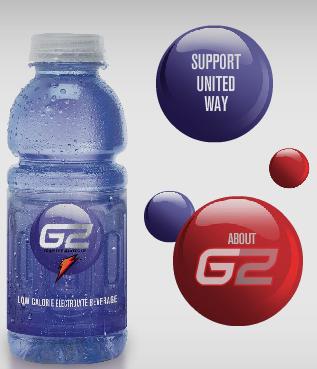
Yesterday morning, while watching the Mike & Mike Show on ESPN, I saw an interesting event that G2 was hosting in collaboration with the Super Bowl. It was an actual (punny)bowling event with who I assume must be football stars. I was flipping channels and barely paying attention, but I heard one of the Mikes say that for every visitor to www.drinkG2.com, a $1 donation would be made to the United Way.
Honestly, I had no idea what G2 was, but was multitasking and it only took a second for me to hit the site so, in a Pavlovian response, I instantly typed in the address. Not only did $1 get donated to United Way (there is $100k max, it appears), but in just a few moments, I learned that G2 is the “light” version of Gatorade with only 25 calories. Shockingly enough, that’s a value proposition that interests me and I just might buy the product.
So, for $1 that went to a good cause anyway, Gatorade bought my awareness and I am now officially “likely” to try. Pretty good deal. This has been used in other campaigns and, while it is a blatant eyeball purchase, it works and doesn’t create waste. This is a great opportunity for charities & brands to partner in a mutually beneficial way and charities should not be afraid to make the first move. Think about the brands that your likely donors or activisits would appreciate, and approach them!
The Today show featured some marketing envorinmentalism – one school’s great results of holding a ”catalog cancelling challenge“. You can join the clutter-free ranks at catalogchoice.org.
While catalogs take a long time to decompose yet are only “good” for a limited time, it appears that viral video can live forever. Just for fun, I started searching for some of the videos that Cole & Weber United produced for me in 2005 and they are still out there. You can still enjoy Mitch Ferrence’s dance lessons, air guitar instruction, and Mark’s ditties - my favorites are “Thanks in Advance” and “Bracketman: A March Tragedy”.
Last night, whilst watching something shameful off my DVR (ah, strike TV), I saw a self-described redneck get a tattoo of a Wrangler jeans label on the part of his body over which that label would normally sit.
So that started me thinking, why do people make their brand love permanent with tattoos? I understand the desire to closely associate with a brand whose philosophy you share, but brands are run by people and change over time. It takes extreme faith in a company’s desire to stay true to the brand’s meaning to break out needles.
Nike is so enamored of the idea of their employees making a permanent commitment, that in Fall 2000, they brought tattoo artists to campus “just in case there was interest” and about 30 “Ekins” (Nike spelled backwards) took the plunge. The phenomenon of the swoosh tattoo rippled out from there. Another extreme example of brand tattooing is Disney Tattoo Guy, who sports Disney icons on 90% of his body. Permanent promotion! Maybe tattoo artists should be brought to more gatherings of brand fans “just in case” someone decides to join the tribe.
Below, I am sharing a smattering of brand tattoos that I found particularly entertaining – the final being a potentially cautionary tale about how tattoo meanings can change as brands do.
Consumer Tats:

Geek Tats:


And, oh, how things change…
Are there any brands for which you feel such a passion that you’d make it permanent? And I thought a weekend was a commitment!

British Airways is taking a new, transparent, clutter free approach to launching their new subsidiary airline Open Skies. On the company website – consisting primarily of a blog and contact information – the request for collaborative product development seems quite sincere:
“We don’t want you to simply witness the creation of an airline, we want you to be part of it. That may sound like puffery, but it isn’t. We hope to prove that your contributions will help make OpenSkies a unique and, invariably, a better travelling experience.”
They are certainly off to a good start. Open Skies flights, starting this summer between New York London and Brussels will have only 82 passengers and feature seats that really recline. The 28 most expensive seats will recline completely flat into 6′ beds.
This type of collaborative product development is the type of thing Jackie Huba suggests in her amusing/disgusting “Meatball Sundae” video in her preventative measures of not having to market a “meatball” in the first place.
Open Skies is an exciting experiment. I hope that Open Skies will close the loop and let us know what elements of their customer experience are user designed. I wonder if they’ll filter input coming from real potential users of this limited service vs. suggestions coming from folks like me who are mainly curious about it as a case study. With only 6 months to go until their anticipated first flight, we won’t have to wait long to see.